
July 2000
The first thing everyone asks when I say I went to Poland is always, “why?” My mother was invited to give a talk on “Anality, Masculinity, and South Park, or Why the Devil is Gay” at the International Conference on Literature and Psychology in Bialystok, which is a small, industrial city in northeast Poland. When she agreed to do the talk, the organizers had offered a tour in conjunction with the conference, but the tour was canceled, so I joined her as the conference was ending to travel around together.
Friday, July 7, 2000
It was a half-day at work, which was good, because I hadn’t even started packing, and my flight was leaving at 9:00 p.m. I hate packing. I’ve always been bad at it. I had no idea what to bring. I called King Rob to ask him to look up the weather in Poland for me. “I can find Gdansk,” he said, “will you be anywhere near Gdansk?” Answering that question would have required either knowing Polish geography or having prepared for this trip, neither of which applies to me. I thanked him, guessed what to bring, and got on the subway.
It’s easy to get to JFK from my house on public transportation; it just takes forever. I left my phone at home and started to go through a weird communications withdrawal on the subway. When I got to JFK, I called the 800 number of my office from a payphone even though it was a Friday night. I checked my messages and left a few. Phew. That felt a little better. As soon as I hung up though, I felt out of touch again.
British Airways offered 12 movies in coach, and they all sucked. I was especially amused to see Maybe Baby listed. I had seen an advance screening of it with Mark, and it was so bad that he wanted to walk out. The airplane movie summary described the characters “trying to sprog,” which was a new one to me. Guess it means breed in England. First class offered 18 movies, including Boys Don’t Cry, which I hadn’t seen, but I wanted to sleep anyway, so I wasn’t upset to miss it. I was impressed British Airways would show something so potentially controversial. I read a theater review of a play with a character named Viveca and promptly fell asleep.
Saturday, July 8, 2000
As we pulled into Heathrow, they announced where we could find connecting flights and “baggagry claim.” I was pleased with the English-ism. Only when we got off the flight did I realize I had just misheard “baggage reclaim.”
After changing terminals, I reached for my Palm Pilot to look up Mat the German’s phone number, but it wasn’t in my pocket. I waited in line at customer service and told them I had left it on the plane. The service rep looked absolutely pained and even raised his voice when asking, “Didn’t you listen to the announcement to take your personal belongings?”
I was so groggy I actually apologized to him. “Yes, it was foolish of me,” I admitted, “but I was sleepy. Anyway, I just got off the plane, I know exactly where I left it, the plane is still on the ground, can you please call back and ask them to hold it for me and I’ll be right over.” He asked me how long I’d been off the plane, and I estimated five minutes; I had come straight to his counter from the plane.
“It takes at least six minutes to get here from there,” he said, “you probably landed 45 minutes ago.”
I asked him if he could call and have someone check the seat pocket in front of seat 47C. The device was small enough that cleaning personnel wouldn’t see it without specifically checking. He told me he’d let me know in 15 or 20 minutes.
I sat down in front of him and waited 20 minutes. When I came back to the desk, he gave me that “can I help you?” look, like he didn’t even recognize me. He said they hadn’t found anything on the plane. I asked whether they’d checked the specific seat pocket, and he said nothing was reported found. He suggested I file a report when I got to Warsaw. I asked if I could do it immediately, but he said the report could only be filed at the baggage claim and I wouldn’t have time to clear customs and get to Heathrow’s baggage claim before my connecting flight. He refused to file any kind of complaint for me.
I still had hours to kill in the airport, just enough to bore the pants off me, but not enough to clear customs and actually go into London. Somehow I managed to get Mat’s number from London directory and have a nice chat with him. Then I browsed the mall and mostly sat and gazed at the monitors listing flights departing to all kinds of exotic places. Where the hell is Larnaca?
As soon as I got to Warsaw, I filed a duty log at the airport’s lost and found. They made me learn how to say “duty log” in Polish and say it over and over. I didn’t admit not knowing what “duty log” meant in English. They also advised me to also file another complaint with British Airways, but first I had to find a British Airways representative in the Warsaw airport, which looks kind of like a bus terminal. I mean before they fixed up all the bus terminals so they look like airports. It looks like the basement part where the buses still are, and to my American snobbish surprise, no one there spoke English. Eventually I found a security gate that said British Airways and a man there who pointed at one of the counters.
As I approached the counter, the woman in the British Airways uniform folded up her little sign, scrolled off the monitor so it flipped from “British Airways” to “Welcome to Warsaw,” and walked away. Right by me. I asked her to stop, but she didn’t. I walked back to the guy at the British Airways security gate, and as I approached, he folded up his little sign and started sweeping up. All signs of British Airways had vanished from the airport. I followed the sweeping man while making my “where do I go now?” hand gestures. His English was just good enough to say “I don’t know” and then when I didn’t leave, “bye-bye.”
I eventually found a small British Airways office on another floor. The only person there told me he couldn’t help me and to come back in 15 minutes. But the sign on the door said the office was closing in five minutes. So I waited outside the door and actually pushed in behind the other employee when she returned so she couldn’t close the door on me. However, she said there is nothing they could do and that I should have reported it in London. She refused to make a report, saying that would imply that British Airways had been at fault for the loss and would owe me money if they didn’t find it whereas this was all my own fault. I agreed that of course it was my own fault and I would waive all claims for damages; I just wanted help getting it back. She said I could call back later to ask if anyone had reported finding it. Bye-bye, little Palm Pilot. Bye-bye.
At this point I couldn’t imagine anything would go right ever again, but I did find an ATM, and it did have an English option, so at least I could get some money. I hadn’t bought any zlotys before leaving home. The ATM asked me how much I wanted, at which point I realized that I had no idea what the exchange rate was. I decided to pick an amount in the middle of the fast cash options, which ranged from 10 to 1,000 zlotys. I asked for 100, and the machine spat out one 100- zloty bill. I had no idea whether I would need another 100 to have enough for a pack of gum or whether I should hide the massive loot until I found a fancy bank to break it into smaller amounts.
My mom’s travel agent had given me instructions about where to find an airport bus to the train station. I couldn’t tell where anything was though, so I hopped on the first bus I saw, and it turned out to be a public bus. The driver, who was chain smoking, wouldn’t talk to me when I asked whether it went to the train station and waved me away when I tried to give him my 100 zloty note, but then he started yelling at me in Polish when I sat down. Since no one understood my Polish pronunciation, I wrote down my destination “DIWORZEC CENTRALNY,” raised my eyebrows, and looked helpless with my 100 zloty note. Finally one old man nodded that not only does the bus go there, but that he was going there and would show me where it was. He also paid my fare and got my ticket punched for me. He wouldn’t break the note, though, and he wouldn’t take the $5 bill I offered him instead. It was a good thing he was there, because soon the transit police entered the bus and demanded to see my punched ticket.
At the train station I somehow managed to buy a one-way express train ticket to Bialystok. My mime skills were already getting much better, and I felt proud of myself, although I had already spent more than half of my 100 zlotys. Maybe I should have used my Visa card. Turns out 100 zlotys was maybe $25, which is a lot in Poland, but I was okay spending the cash. Later I found out I had a pre-paid voucher for the train anyway.
Besides Polish, the signs on the train were in French, Russian, and German. English wasn’t even in the top four languages. I had never felt so lost, but the silence of not understanding the language was almost becoming soothing. The trip took a few hours. Mostly I slept. I got there. I found the hotel. I found my mom! Always good to find your mommy.
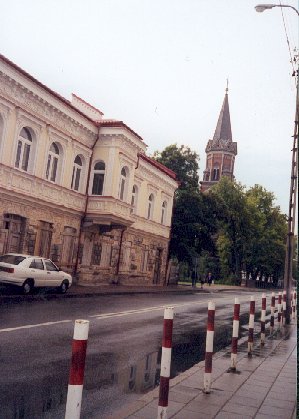
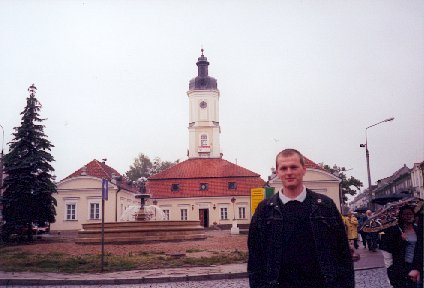

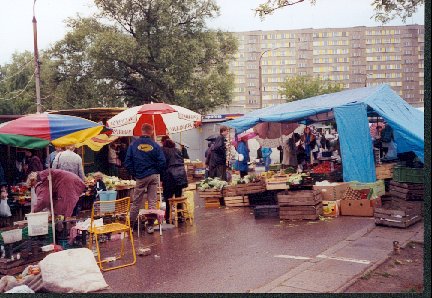
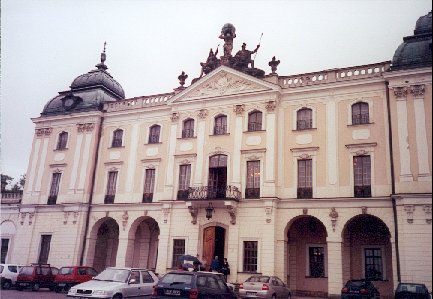
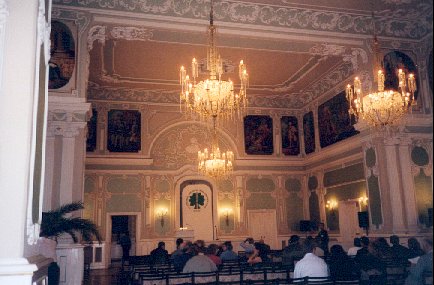
Bialystok is small and industrial. We went for a walk, stopped in to see the old castle (now a university building with a concert in the main hall), and had dinner in the hotel: cabbage soup, wild boar, and duck. There wasn’t anything to do at night in town, but one of the conferees was showing Casablanca for a talk, so we went to watch that. The copy the university provided him was voiced over in Polish, however, so we couldn’t hear the English. It wasn’t not dubbed; there was just one voice translating everything slightly off-sync, so you could hear the beginning of each sentence in English, and then just Polish. The man showing it explained what was going on to the small audience of mostly American academics. I couldn’t believe anyone hadn’t seen it. When they started asking questions about the plot, “but I thought Rick liked Ilsa?”, I remembered why I left the academy. I wished my mom had brought the South Park movie on PAL to show for her talk. I wonder what questions they would have asked about that.
Sunday, July 9, 2000
Buffet breakfast in the hotel: fish, maybe four kinds of jellied meats, lots of mayonnaise-y “salads.” My mom pointed out one of the men in her group who had been an American G.I. at the liberation of Dachau. He told them the Nazis hadn’t bothered to open the cattle cars towards the end of the war, so the American soldiers came in and opened train cars full of hundreds of bodies.
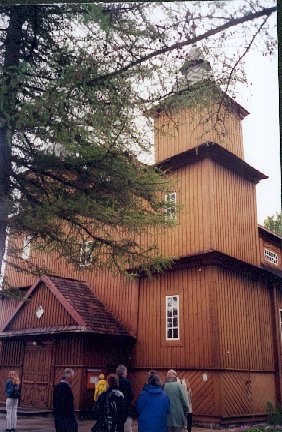
We got on a tour bus with the academics. First we saw an 18th century wooden church full of strange tchotchkes and figures sticking up from or leaping off pillars. We found a brochure and figured out that the church was trying to encourage us to “spiritually adopt” the aborted fetuses of the world by praying for them. I didn’t.
White storks nest on roof tops and on pillars in the fields. We passed a weird-looking orthodox church that some of us wanted to check out, but the guide said we were late and that we could come back after dinner. We drove to a national park and saw bison, red deer, wild boar (mm, I’m getting hungry again), and I spotted a few good mushrooms.
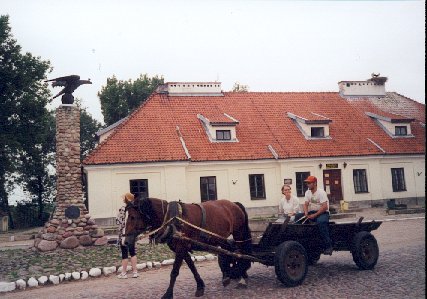
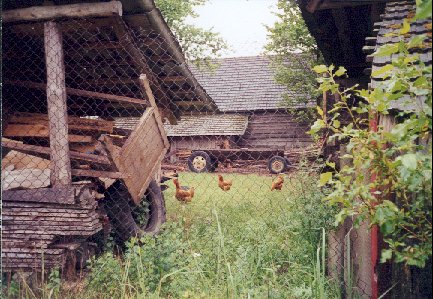
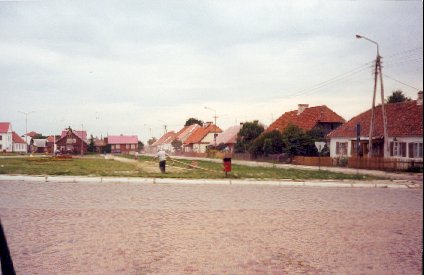
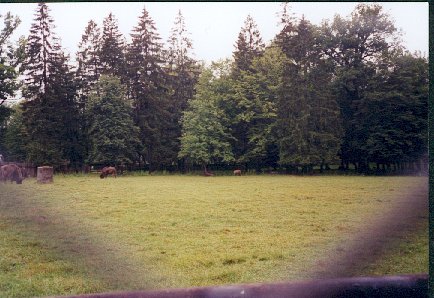
Dinner was the farewell banquet for the convention. Relatively set menu, with a few choices. I had borscht and wild boar. We drank vodka flavored by the grass the bison eat. I bought some extra bison grass from a wooden stand to make my own vodka. During the banquet I hiked back along our bus route where I had seen a circus poster. I carefully copied everything down, because I couldn’t even figure out the dates much less the location, but when I got it translated I learned that I had already missed the show.
On the hour-long bus drive back to the hotel, the passengers voted against stopping at the orthodox church because it was already maybe 9:00 pm. Academics need their beauty sleep.
Monday, July 10, 2000
Bus to Warsaw. We drove through forest, and every few miles saw a young woman signal the bus or hike up her skirt, prostitutes along the side of the expressway in the middle of nowhere. I guess they take customers into the woods. We could overhear the academics behind us discussing the progress they were making in therapy.
Mom and I jumped off the bus at its first stop in Warsaw and walked to the hotel. On the way we passed a shoe store called “New Rock Super Buty.” Turns out buty means boots in Polish, which was a running source of amusement for me for the rest of the trip.
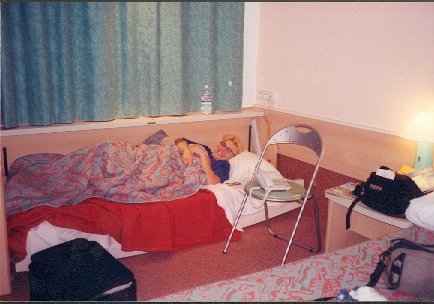
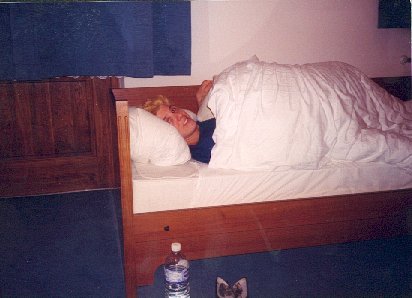
We asked the clerk at the hotel desk whether she spoke English. No, she said, but she talked French. Well, my French is appalling, and my mother’s is no better, but eventually we managed to get her to understand that we had a reservation. We got the key and headed to the room, which we discovered only has one bed. We called the front desk, and the clerk who answered spoke English. Why didn’t our clerk let us talk to him in the first place? Anyway, he explained that the only double rooms have one bed for adults and one for children. We asked to see it, so after we turned in our key, someone who spoke no English lead us into another room, which we took. Along one wall was a tiny ledge, which folded down to become my bed.
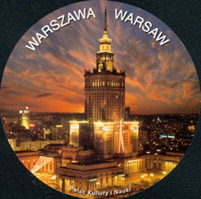
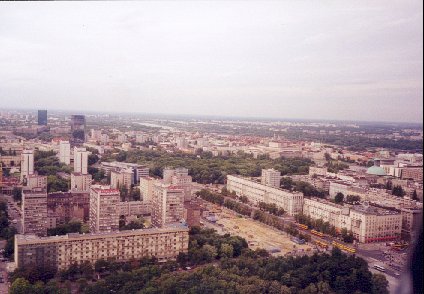
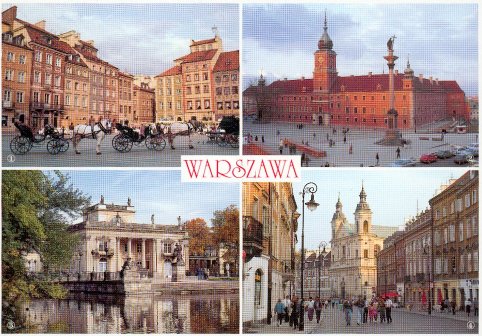
We went for a walk around Warsaw, ate Lithuanian dumplings, saw the outdoor markets, and visited the Soviet-built Palace of Culture and Science.Warsaw is hideous. 85 percent of it was destroyed in WWII, and what has been re-built is cheap, communist cement crap. There was a ton of new construction, apparently competing to put the most colored glass up the fastest, and a few nice buildings that survived because Nazis took them over during the war.

We went back to the hotel to meet Helena, a Polish feminist academic friend of a friend of my mom’s and the only actual Pole we had plans to meet, so we were excited. She was supposed to meet us at 6:00 pm. At 6:30 we called the front desk to remind them we had switched rooms and let them know we were expecting a visitor. Then we waited. At 7:00 Judy went down to see if Helena was waiting in the lobby. No sign of her, and the desk said we didn’t have any messages.
Around 7:30, I called down and they said they didn’t have any messages for us. I asked them to double check, and they kept me on hold a while and then came back and said a woman was waiting for us in the lobby earlier, but she hadn’t left a message and anyway she would be back. I asked how they knew she would be back: did she say it or did she leave a message. They put me back on hold. Then they said there was a message for us, but they didn’t tell us what it says. Plus, they kept refusing to put on anyone who spoke English, so we had to argue in French. We went downstairs and got the message, and it was from Helena who had waited for us for 30 minutes in the lobby because the hotel said they had no record of us as guests. Infuriating.
In the meantime, by the way, I also called the Warsaw British Airways office. After trying several times with no answer, someone answered who told me they couldn’t help me and to call back between 4:00 and 9:00 p.m. I reminded them that the office closed at 4, but they promised someone would be there. Do I even need to finish this paragraph? They never answered the phone again. Polish customer service. Hmm.
While we were waiting around the hotel room, I had fun reading some of the Polish tourist information. My favorite parts included “Why do Poles drink so much?” (Answer: Polish per capita drinking is only about third highest in the world, but other countries are prejudiced against vodka drinkers) and “Should visitors be afraid of the police?” (Answer: Foreigners better respect our laws). Not very warm or reassuring.
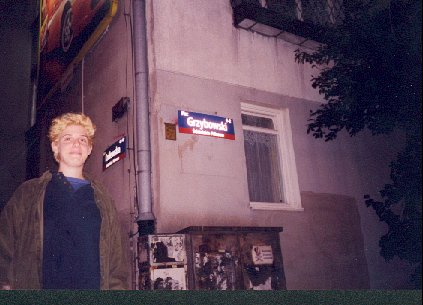
Waiting so long in the hotel room, we had plenty of time to check out the Warsaw restaurant guides, and we discovered that the only kosher restaurant in town is at Grzybowski 2. No I don’t keep kosher, and neither does my mom. It was the address that struck us. We have a letter from 1940 that American Express sent my great-grandfather saying that his brother Isaac, who lives at Grzybowski 14, needed money. Grzybowski 14 was in the heart of the Warsaw ghetto, and we wanted to try to find it, so we took a cab to the restaurant. Dinner was okay. We had goose and “Jewish caviar” which turned out to be chopped liver. No one working there was Jewish, and the food just tasted like all the greasy Ashkenazi food here. (That is by no means a complaint.)
After dinner, since no one spoke English, I wrote down “Grzybowski 14?” and showed it to the staff. They shrugged their shoulders and pointed outside for us to ask a taxi driver. I wrote down “Grzybowski 2” and pointed down at the restaurant we were in. They asked what we were looking for, a synagogue? I drew a family tree with dates, pointing to myself and Judy for generations and circling someone before us living there in 1940.
“Ah, du suchst deine familie!” says the one waitress who spoke a little German. I nodded excited that she understood and would help us, but understanding isn’t helping. Finally satisfied with figuring out what we wanted, she shrugged and turned away, not caring whether we found it.
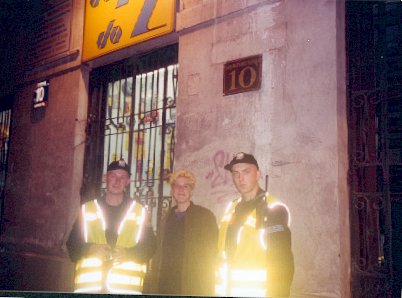
So we walked around for a while. The closest we came was Grzybowski 10. We found some cops, very young scary shaved-head cops in black boots with yellow vests, and we pointed to the “Grzybowski 14?” again. They pointed back to the restaurant we had just exited. We said no, that’s 2, and they shrugged.
Anyway, we had promised my Aunt Gay Lynne we would take a picture near Isaac’s house if we could find it, so I asked the two cops to pose with me in front of the street address. One panicked and tried to refuse, but the other one talked him into it eventually. I wonder whether they’re really this unhelpful to everyone, whether they treated us worse because we were American, or whether they looked down on us because we were obviously looking for a Jewish home.
After that unsatisfying adventure, we went back to the hotel, and mom chatted on the phone with Helena, who said not to judge all Poles by our experiences and gave a very promising report on the state of Polish feminism. She also told us she stopped at the doctor after waiting for us and was diagnosed with pneumonia, so we felt pretty awful for keeping her waiting. Helena had also left us another message we hadn’t gotten, and when mom finally got someone at the desk who spoke some English, she complained. The staff blamed each other for a while and then someone apologized.
Tuesday, July 11, 2000
We were quite surprised that our wake-up call actually came as requested at 7:00 a.m., and it was an English recording. The hotel did something right! Mom got in the shower, and of course I went back to sleep until it was my turn. I was less impressed when we got a second, unrequested wake-up call at 7:05.
Breakfast was fine. More jellied meats. The board at the front desk said we had a message, but we didn’t, or at least nobody could find it. We took a taxi to a nice, big tourist-y hotel (ours was mostly business travelers) from which we were picked up by a bus for a guided tour of Warsaw. Our guide, Barbara, had a funny, high-pitched voice. She sounded terrified. Our driver’s name was Josef, and he looked terrifying. A lot of the tour narrative was about how nice Krakow is. Even the tour guides didn’t pretend Warsaw was nice.
We did learn some interesting history. For one thing she explained the names: Poland means people of the fields. Historically, there were no Polish cities. All the cities in what is now Poland were settled by German-speaking Silesians. Warsaw gets its name from the legend of its founding. A fisher caught a mermaid. She predicted he would have a son and asked the fisher to name him Wars. She predicted he would have a daughter and asked him to name her Zawa. In exchange she promiseed him something or another (maybe to defend his children). The symbol of Warsaw (Warszawa in Polish) is a mermaid with drawn sword.
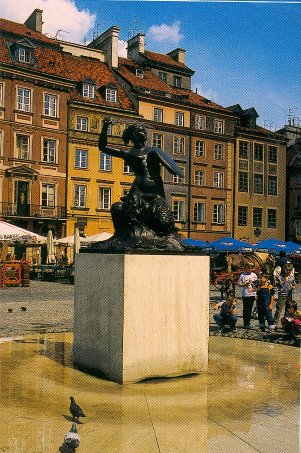
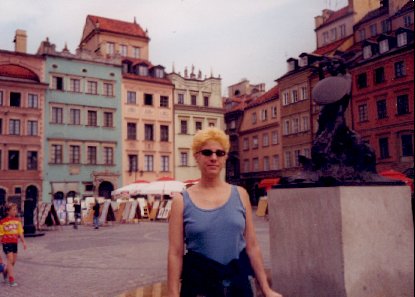
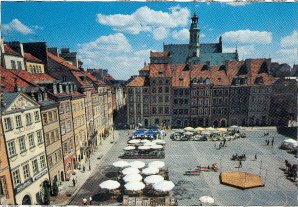
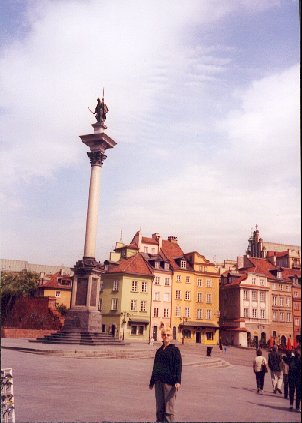
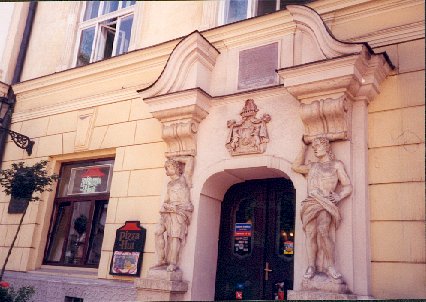
We headed into the “Old City,” which I put in quotation marks because, remember, 85 percent of Warsaw, including all of this area, was destroyed in WWII. Before the Germans invaded, the Poles hid a ton of furniture, art, and other palace valuables in basements around the city, and they managed to save about half the contents of the castle, which was totally destroyed. (Viveca: so they knew they were about to get their asses kicked? Judy: so they’re proud of saving 50 percent of the art in their basements, but they don’t mention that they saved about 0 percent of their Jews? Did they run out of room in those basements?) Anyway, after the city was destroyed, they used the old paintings they’d saved to recreate their entire historic area, building by building, as a replica of what it was. The paintings were old, so the Old City, which was built in the 1950s, looks the way it did in the 15th century—not the way it did in 1939 before it was destroyed, because they didn’t have pictures of how it looked in 1939. Pretty weird. And the “New City,” also built in the 50s and 60s, looks all 18th century.
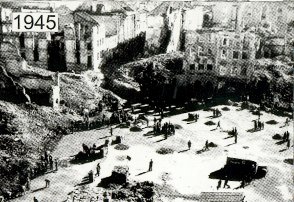
Reconstruction of the area occupied by the Warsaw Ghetto didn’t start until after the fall of communism. The tour guide said it was good that the communist governments didn’t rebuild there because this way businesses would be able to use that prime downtown land. I had never understood what the Warsaw Ghetto was until this trip. I had thought it was just a poor Jewish area, like when we use the term ghetto here. Actually all Jews were forced to live in this area and eventually the gates were sealed so that no one could legally pass in and out. This area was in a city, so it’s not like they could grow food. We saw films and photos of the Warsaw Ghetto with dead bodies on the street. By the time the Nazis offered to “resettle” people in the East, ghetto residents were so pleased to get a chance out that they paid to get on the cattle cars that wound up taking them to Treblinka to be gassed.
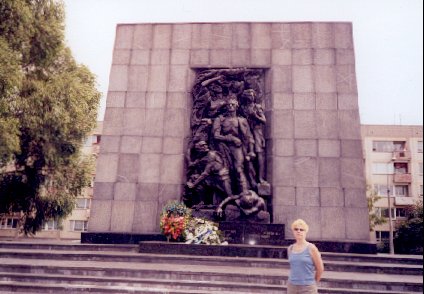
We stopped to see a monument to the Warsaw Ghetto victims, and we noticed that the German tourists didn’t get off the bus.The old man may have actually been a WWII vet. To be fair, they didn’t get off the bus for much; they were pretty old.

We visited a nice summer palace.
Back to the train station, and with the help of my mom’s trusty Polish phrasebook, I conveyed the information that we wanted to buy express tickets to Krakow and purchase them with our pre-paid vouchers. I was very proud of my Polish.
For a snack in the train station we each got a cup of soup. I got borscht, which for some reason always comes with “croquet,” a fried thing. Mom got something without knowing what it was (she’s awesome), and it turned out to be tripe soup. It was okay but greasy even for Poland.
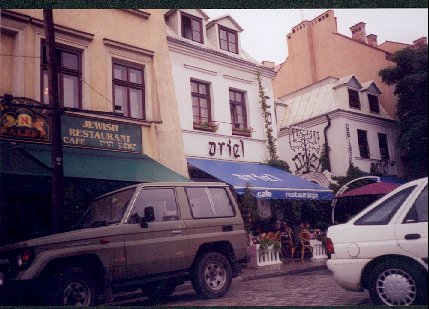
In Krakow our hotel was in Kazimierz, the old Jewish quarter. The Krakow Ghetto was elsewhere, but this area was used for it in Schindler’s List. Since then it had gotten some tourists, and you could get special “Jewish” dinners. Helena Rubenstein grew up here. We walked around and visited old synagogs. One of them had life-sized cardboard cut-outs of Jews inside the synagog (now a museum). Krakow had 70,000 Jews in 1939 and was only back up to 150, so they made fake ones to pose in the synagog. We also saw Jew doll novelties everywhere.

For dinner we ate outside at one of the Jewish restaurants and had stuffed goose necks. Greasy. German tourists listened to Klesmer music inside while we underwent cognitive dissonance.
Wednesday, July 12, 2000
I dreamt I was at rehearsal for the Big Apple Circus school program’s Spring Show and woke up upset about work and unable to fall back to sleep.
Another hotel breakfast. Then to another fancy hotel to meet our tour, Jane, who was a proud Pole and also a smelly one. She was also very bossy, which was hilarious. She made strangers move off church benches to make room for our group.
The highlight of the day and of Krakow in general was the Wawel (pronounce the w’s like v’s), a medieval castle/cathedral complex with multiple buildings built on top of each other and added to throughout the centuries. Excellent tapestries.
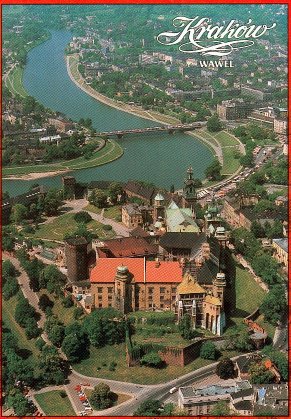
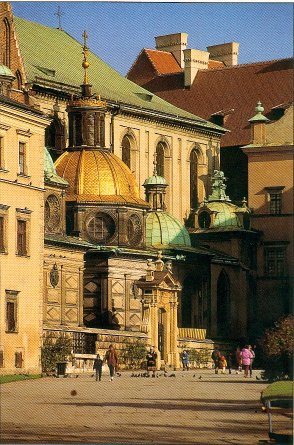
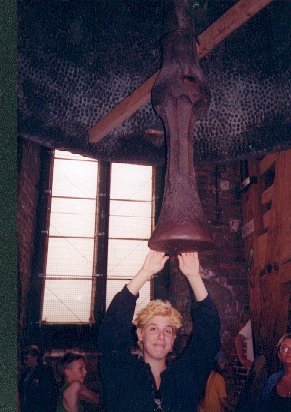
The symbol of Krakow is a dragon that lived under the Wawel. We also saw lots of Tartar symbols from an old battle. The Tartars had invaded violently, but the Poles re-stage the invasion in festivals with “friendly” Tartars. The coverings on the Tartars’ horses makes them look like chickens.

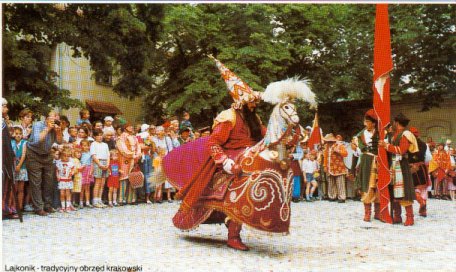
Downtown has Europe’s largest market square. It struck me funny to see pushcart vendors selling bagels. I had a pique of New York snobbery until Judy pointed out that bagels in fact had most likely been brought to America by eastern Europeans. We hypothesized tha bialys migh have been invented in Bialystok, but we couln’t find out for sure. Bialy means white in Polish though, so maybe not. Anyway, I had to admit the Polish bagels were pretty good. Lots of the street food was.
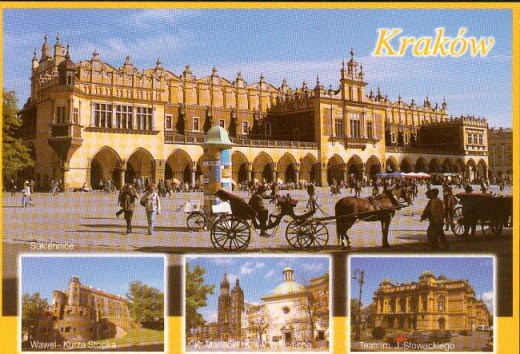
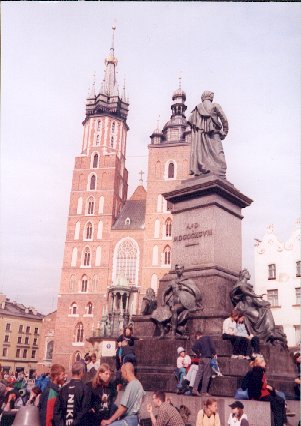
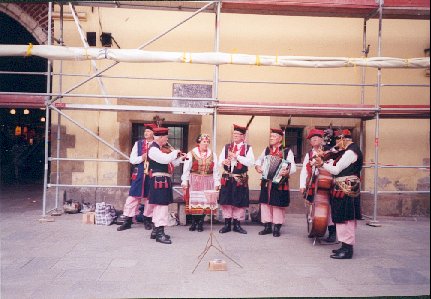
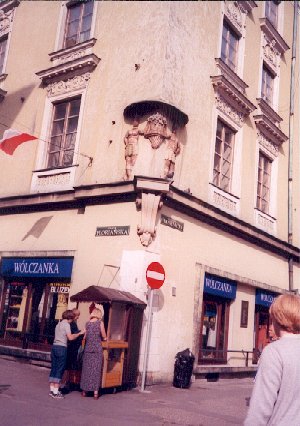
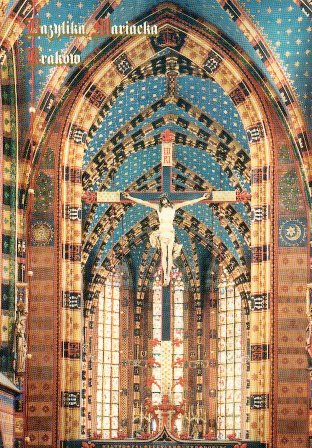
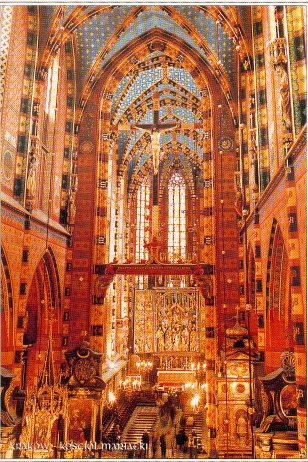
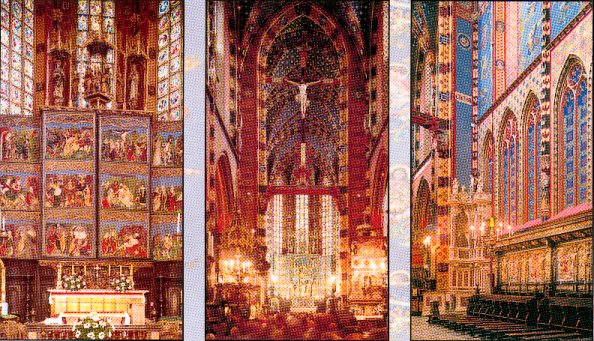
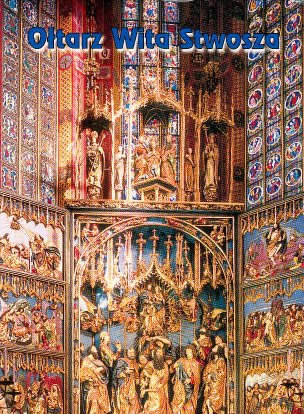
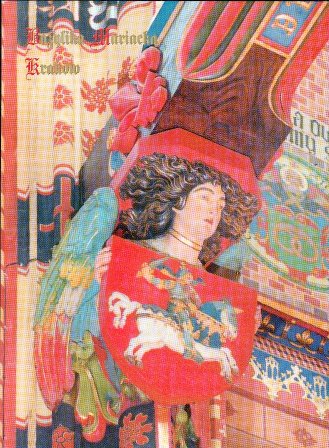
We also visited an amazing church with bright colors everywhere and gold figures looking about to leap off all the cross beams. My favorite part was by the organ, where there was a whole band of angels with musical instruments (of course, this seems to be the only part I don’t have a picture of). Unfortunately actual Catholics kept praying in the way of my sight-seeing.


For lunch I ate a pig’s knuckle and drank berry-flavored vodka. Well, actually I ordered a pig’s knuckle and mostly just ate mustard for lunch. Pig’s knuckle is just a big ball of fat, and I couldn’t choke it down.
More churches and knick-knack shopping.

It started to rain so we went back to one of the synagogs to watch old films including footage the Germans shot of the ghettos and camps that they meant to use to make propaganda movies but never did (realizing, apparently, that the images were not working in their favor). The movies made it pretty clear that the Poles knew exactly what was going on and were not, as they kept claiming, innocent victims or ignorant bystanders to Nazi atrocities. The films also made me feel warmly towards the communists, who were sneaking weapons and food into the Warsaw Ghetto from the beginning.
Dinner was beer, stuffed grape leaves, and cold soup in Kazimierz. My skin was beginning to hurt from the pollution. We watched Moonstruck in Polish on TV, again with the weird voice over instead of dubbing. My Polish was improving very slightly.
Thursday, July 13, 2000
Today we visited Auschwitz and Birkenau. I was torn about whether I should even try to write about it. We saw two tons of human hair, wall-to-wall shoes, and a room of eyeglasses. It was so strange and elaborate. The most arresting thing is the scale, so much bigger than I had imagined. In Birkenau, we couldn’t even see all the way from the entrance gate across to where the crematoria where. The brick buildings are still standing, but only the chimneys remain of most of the 300 wooden buildings the Nazis burned on their way out. It’s so contradictory. If they believed they were doing the right thing, why did they clear the area and then try to hide the evidence?
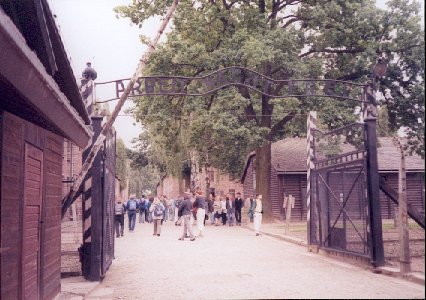
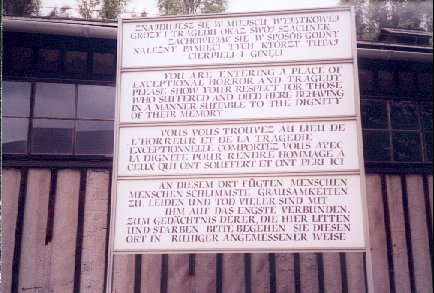
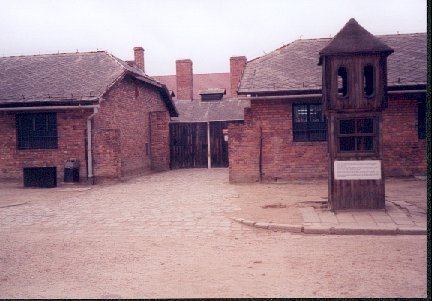
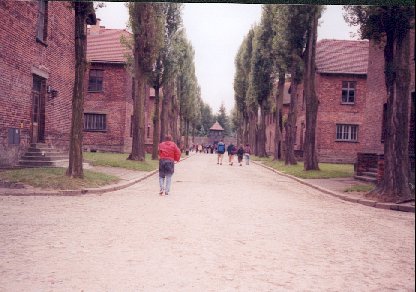

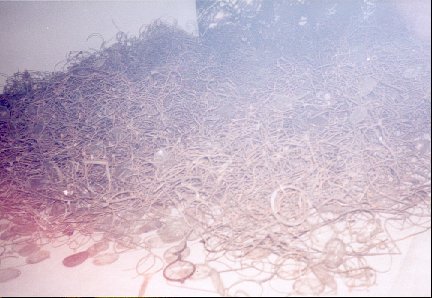
I can’t remember the tour guide’s name, but she was very good, respectful and knowledgeable. It’s very competitive to get a job there, and they have constant continuing training with survivors.
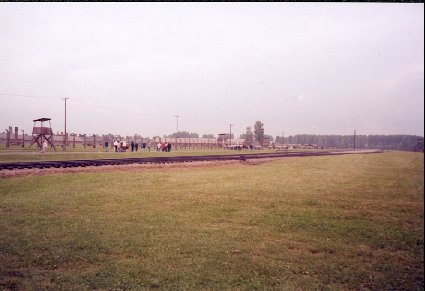
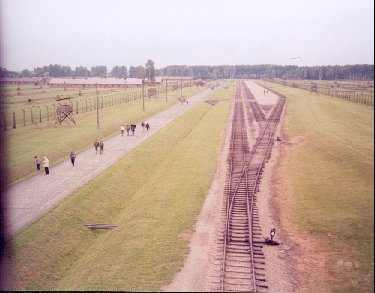
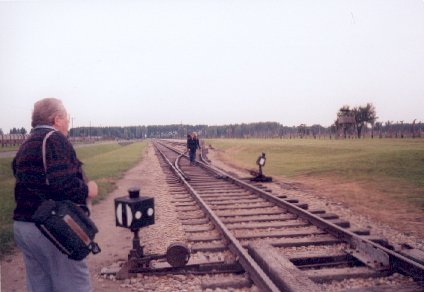
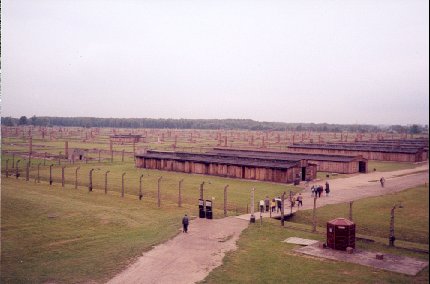
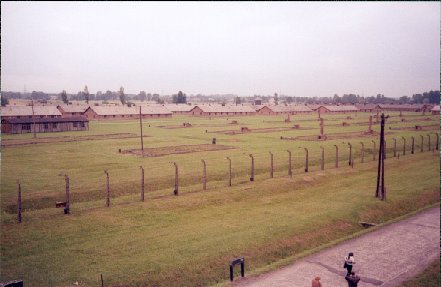
The walls in some barracks were lined with pictures of inmates, but none of the faces were Jewish. 90 percent of the people killed there were Jewish, but almost all of them were killed immediately upon arrival and never lived in the camps. The life expectancy even in the “work camps” was about three months. The work they did consisted mainly of building new buildings for the next round of slaves to spend their final three months in. The plan was death by starvation. It’s cheap.
For some reason the area that made the biggest impact on me was the starvation and standing cell gallery. It just seemed so strange to sentence someone to death by starvation when they were already within three months of dying by starvation. The standing cells were tiny brick rooms with two-foot doorways where prisoners were sentenced to stand all night, four in a room the size of the closet, entirely bricked in. If they survived the night, they worked the next day and went back in.
The whole thing was of course so strange and evil and pointless, but it almost worked.
We took few pictures and didn’t buy postcards. I don’t want a picture of myself leaning in an oven or trying to escape through an electrified barbed wire fence. I can’t talk about this. Go buy a book.
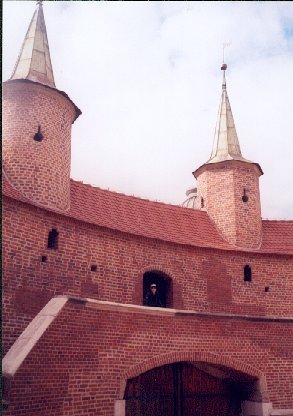
We returned to Krakow and saw the barbican and some other stuff we hadn’t. I ate a “kebob,” which turned out to be a gyro, and bigos, which is a very traditional hunter’s stew of cabbage, meat, and grease. Yes, grease was a listed ingredient. The bigos tasted better when I stopped looking too closely at the chunks in it.
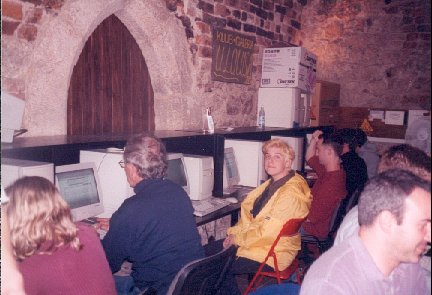
I found an Internet cafe in a basement with medieval-looking thick stone walls. Before I left, I had been in the middle of planning a quite big event at work, and I had left a ton of details up to Eric, so I sent him a note and before I’d even finished checking my messages, he had written back to reassure me that everything was fine. Amazing.
That night we sat outside waiting for our train to Prague. I had 110 droszy left, about 30¢. Perfect.
The weather was really funny this trip. Within the same day I was sweating in a tank top and then shivering despite every layer I brought piled on top of each other. Everywhere we went it was cold and rainy (they kept telling us the weather was typical for March, even though we were there in July!), but it was clear and beautiful every time we left a city. We thought up a new slogan for Poland: “It’s a great place to leave!”
We had a sleeping car! So cute! It made me think of, well, I was going to say a scene in one of The Thin Man movies, but really it’s every old movie. I had only been on a sleeping car once before in my life, and that was back in high school.
We were scheduled to arrive very early the next morning, so we tried to sleep, but I couldn’t. Visions of Auschwitz kept running through my head, and the tiny car with the little sleeping pallet quickly turned from cute to claustrophobic as we raced through eastern Europe. I read a Victorian-style novel and tried to stop thinking about it. At 1:30 a.m., I was still awake when someone pounded on the door. Jackbooted border officers demanded our passports. Beyond them in the halls I saw maybe 20 other official personnel, in several different uniforms. My stomach was upset, and my whole body hurt. We got our passports stamped and approved, but I didn’t sleep that night.
Friday, July 14, 2000
By the time we got to the Prague train station, I felt completely queasy and weak. Gypsy cab drivers, hotel reps, and all sorts of other characters approached us aggressively. We didn’t have any Czech money, and the multiple currency exchanges wouldn’t take zlotys (turns out no one accepts zlotys, even later at home in Chicago, with the world’s second largest Polish population, my mom couldn’t change hers). Eventually we found a bank-o-mat, or ATM, and got some krone, which are about 1/10 a zloty or 30-something to a dollar.
Judy started looking for a metro map, but since I was beginning to black out in exhaustion, I insisted on taking a cab. She tried to ask the driver what the fare would be, knowing he would otherwise rip us off, but I said I would pay and begged to just go. He did rip us off, badly. Moms are always right.
The hotel wouldn’t let us in the room for hours. We washed up and go got some breakfast. It was the first meal definitely of the trip and maybe ever at which mom ate more than I did and faster. Eating did help me recover though.
We went walking around visiting synagogs, because we knew they wouldn’t be open the next day (Saturday). The coolest one was called the Spanish synagog. It was a Victorian fantasy of Moorish influence. In the novel I read on the sleeping car, the protagonist staged a Spanish-themed event, so I pictured that here. I hate being the limiting factor, but I was worried about passing out, which I have a bad tendency to do. I didn’t.
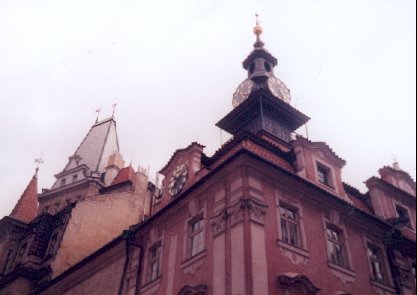
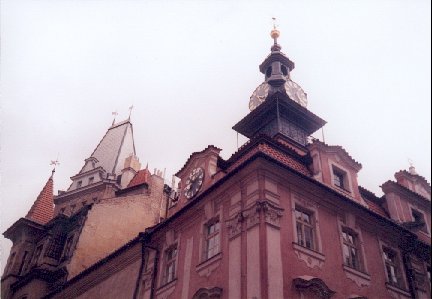
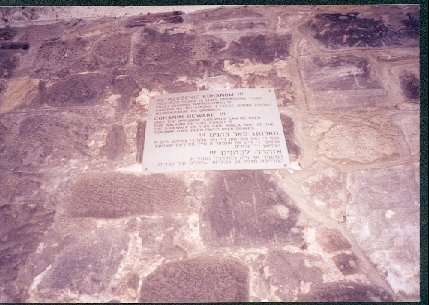
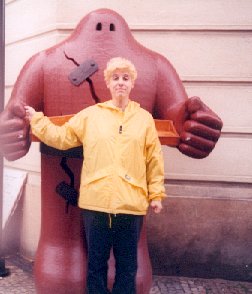
One symbol of Prague is a golum, which is possibly even cooler than the mermaid with sword, the dragon, and the Tartar. It’s a demon summoned by a 16th century Rabbi to protect the people. Cute, but too bad it didn’t work better.
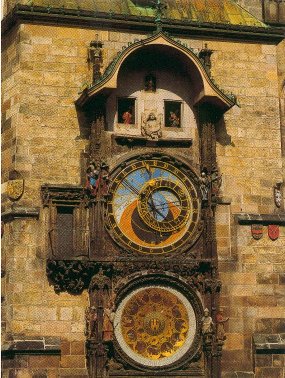
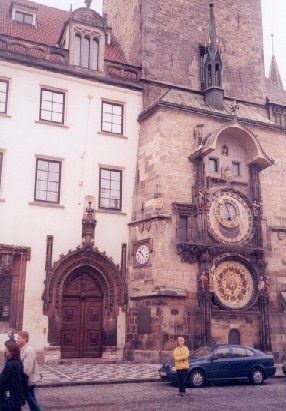
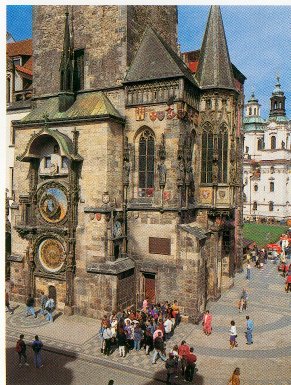
We visited a memorial to the victims of Terazim and saw art the children had made in the camp. An actual Jew worked at one synagog, and the Hebrew clock ran backwards. The main town square had this amazing astronomical clock. Every hour when it struck, mechanical figures moved: death marked the time with an hourglass, saints paraded by, and a rooster crowed.
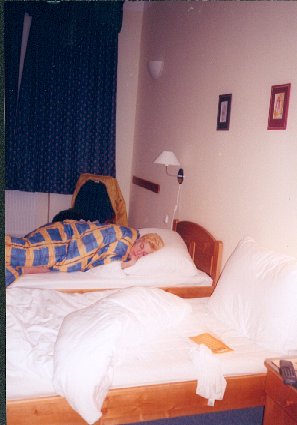
Beer and salad and back to the hotel for a two-hour nap. I was beginning to like eastern European bedding, which was very odd. Frequently the sheet was folded in a long skinny strip down the middle, so the bare mattress poked out on either side. The pillows were dense and square, and any covers were thick down but placed sideways. Mmm. Nap.
I woke rested but even sicker to my stomach, which didn’t stop me from having fried cheese (with lemon and berries), garlic soup, and beer for dinner. I knew I would never be coming here again, so I didn’t want to let a little sickness stop me from experiencing it all.
That night we saw a marionette production of Don Giovanni, which was very funny. The puppeteers appeared in the show too. Afterwards, we sat in the main square drinking beer (Czech Budweiser) and watching the world go by. My cousin Amelia was visiting the Czech Republic for a panel at about the same time we were, so we kept trying to spy her among the drunken crowds of teenagers. No luck. My head had been hurting almost 15 straight hours, and the rest of me didn’t feel so hot either.
Saturday, July 15, 2000
Yogurt and fruit again to settle my stomach. This time our tour bus was split between two guides, Magdalena was our bored English-speaking one, and there was also a man leading the tour in Spanish. Although they both spoke Czech, neither speaks the other’s second language, and I was surprised to notice how different their views of the city were. We split up from the Spanish speakers to tour the Hradcany Castle, which was really more like a medieval village than a palace.
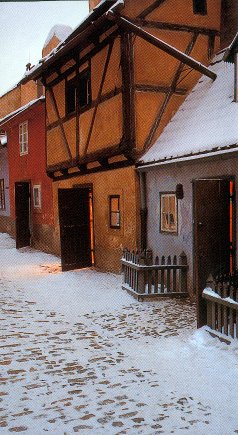
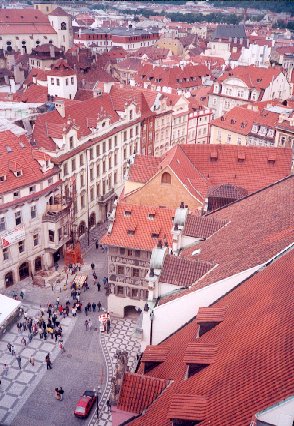
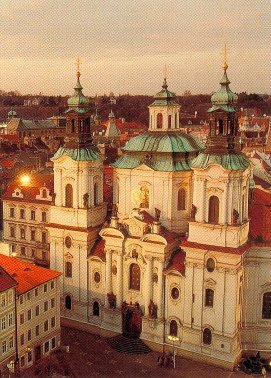
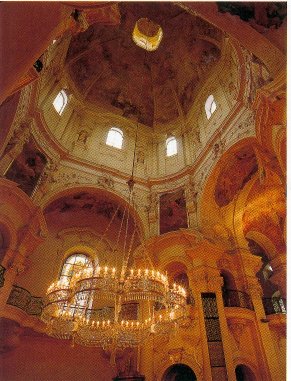
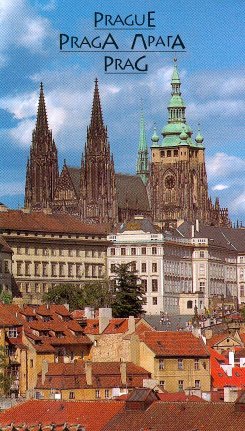
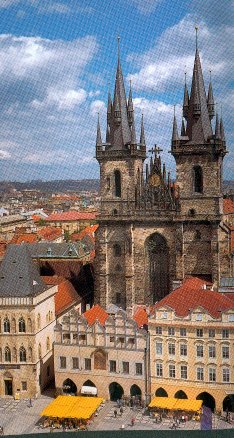
Afterwards, mom and I walked over the Charles Bridge and strolled among art dealers and street performers. We visited Town Hall‘s exhibit on Prague from primeval times to the present and admired the amazing view of red rooftops from the clock tower. We visited lots more churches.
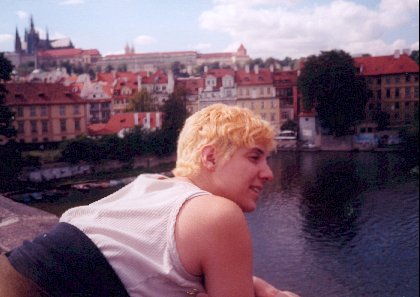
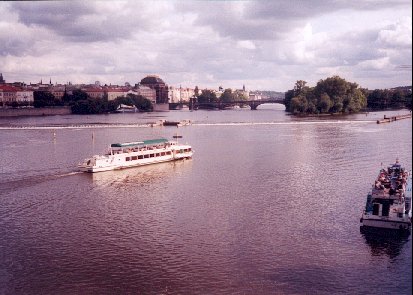
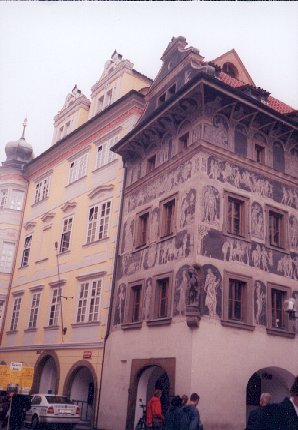
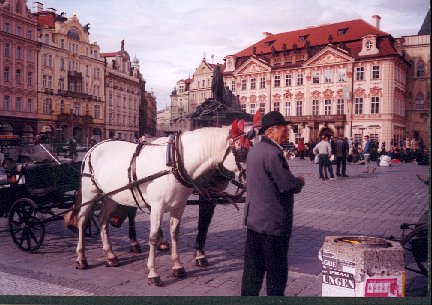
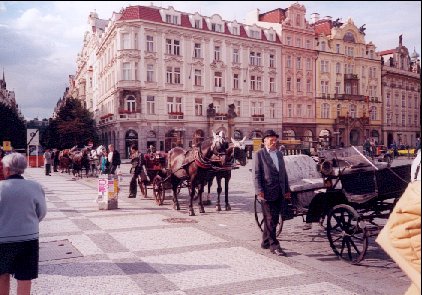
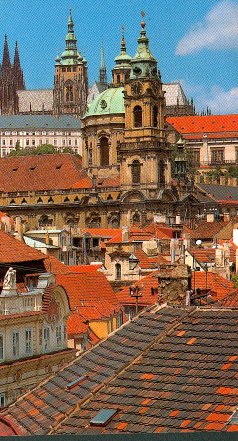
For dinner I ate frogs’ legs and drank beer, and mom had wiener schnitzel while we people watched.
Sunday, July 16, 2000
We woke at 5:30 a.m., and I was still sick enough to be nervous about the flight home. Luckily English was the second language in the airport. The Azerbaijan wrestling team was on my flight.
Groggy in Heathrow., I realized that customs wouldn’t let me bring the Buffalo grass into the country, so I went to the duty free shop and bought six large bottles of vodka. I opened each bottle and split the grass among them figuring placing a plant in alcohol would render it sterile enough to get through. The other passengers are bemused at my opening multiple bottles of hard liquor at maybe 6:00 a.m.
Sometimes it’s good to come home.
About six months after I wrote that, I got an email from a friend, which is below. At the time, I had no idea what he was talking about, but once I figured out it was a response to this post, it turned out to be a direct answer to a question I’d asked. So now I know, and you will too:
Larnaca (originally called Kition in the days of the Old Testament) is a port city in the southern part of Cyprus.
The town is built over the ancient site of Kitium, and excavations have brought to light important finds, including a Phoenician temple dedicated to Astarte, city walls, baths and a house of the Hellenistic period.
Larnaka reached a heyday as a commercial center in the 1700’s, when the consulates were established here. The city offers rather limited sightseeing attractions, but this is an ideal place for sunbathing; there are nice sandy beaches there.